

Imagine walking into a supermarket and picking up a jar of peanut butter with the store’s own brand on it. The jar looks professional, the price is competitive and the product is solid. But here’s the thing – the supermarket didn’t make peanut butter. It was made by a manufacturer who let the retailer slap their own label on it.
That, in a nutshell, is white labeling.
It’s one of the oldest business strategies in the world. Yet, it’s become more relevant than ever – especially in the digital age where software products, marketing tools and SaaS platforms are bought and sold the same way consumer goods are.
Whether you’re a freelancer who wants to offer branded tools to clients, an agency looking to scale without hiring developers or a business owner exploring new revenue streams, understanding white labeling could completely change how you think about building and selling products.
In this guide, we’re breaking down everything: what white labeling really means, how it works in practice, what types of businesses use it and yes – we’ll even show you what it looks like in the WordPress world.
What is White Labeling? How White Labeling Works
At its core, white labeling is a business arrangement where one company produces a product or service and another company sells it under its own brand name.
The producer is often called the white-label manufacturer or vendor. Handles all the heavy lifting, like research, development, quality control and updates. The reseller, sometimes called the white-label partner, focuses on branding, marketing and customer relationships.
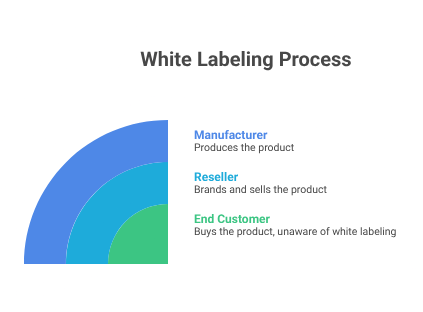
Here’s what the typical white-label process looks like, step by step:
- The manufacturer builds a product (software, tool, physical good, service).
- The reseller licenses or purchases that product.
- The reseller applies their own brand logo, colors, domain name and support identity.
- The end customer buys the product, thinking it’s entirely the reseller’s own creation.
- Everyone wins: the manufacturer gets volume sales, the reseller gets a product without building from scratch.
It’s clean. It’s efficient. And when done right, nobody in the customer’s seat even knows there’s a third party involved.
Think of it like buying a ready-made house versus building one from scratch. You still put your furniture in it, paint the walls your color and call it home. The foundation was already there.
Types of White-Labeled Products
White labeling isn’t limited to one industry or product type. It spans a remarkably wide range of sectors.
1. Physical Products
This is where white labeling originally took root. Grocery store brands, private-label cosmetics and unbranded electronics that get repackaged under dozens of different names. All of this is white labeling in the physical goods world. A single factory might produce the same hand cream for 30 different brands. Each one puts its own label on it. Each one sells it at its own price point.
2. Software and SaaS
This is where white labeling has truly exploded in recent years. A company builds a CRM, an email marketing platform or a reporting dashboard. Agencies and resellers license it, rebrand it with their own logo and domain and sell it to their clients as their own proprietary tool. The clients never see the original product’s branding; they just see the agency’s.
3. Digital Marketing Services
SEO agencies, PPC management firms and social media companies frequently white-label their services. A small agency might promise full-service digital marketing to clients but outsource the actual SEO work to a specialized provider who delivers everything under the agency’s name.
4. Financial Products
Banks and fintech companies white-label payment processors, lending platforms and investment tools. When you use your bank’s mobile app to send money, the underlying infrastructure was probably built by someone entirely different.
5. Apps and Mobile Tools
App development is expensive. White-label apps let businesses offer mobile experiences to their customers without spending hundreds of thousands on custom development. Fitness apps, booking platforms, food delivery apps – many of these are built on shared white-label frameworks, customized for each client.
White Labeling vs. Private Labeling: What’s the Difference?
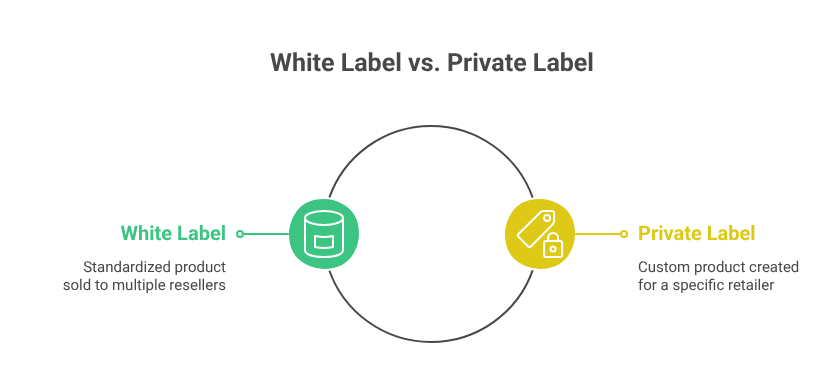
People often use these terms interchangeably and while they’re closely related, there is a meaningful difference worth understanding.
White labeling means a manufacturer produces a standardized product that is then sold to multiple resellers who each brand it as their own. The product is essentially the same for every reseller, only the label changes. Think of a generic web analytics tool that 50 different agencies rebrand and sell under their own names.
Private labeling, on the other hand, typically involves a more exclusive relationship. A retailer works with a manufacturer to create a product specifically for them. Often with unique formulations, features or designs. The result is a product that feels genuinely proprietary to that retailer.
The simplest way to remember the distinction:
- White label = same product, many brands.
- Private label = custom product, one brand (or very few).
In the software world, the lines blur a bit more. Many white-label SaaS platforms allow significant customization, making the reseller’s version feel genuinely unique. Which is why the terms often get used loosely and interchangeably in tech circles.
Pros and Cons of White-Label Products
Like any business strategy, white labeling has genuine strengths and real limitations. Understanding both sides will help you decide if it’s the right move for your business.
Advantages of White Labeling
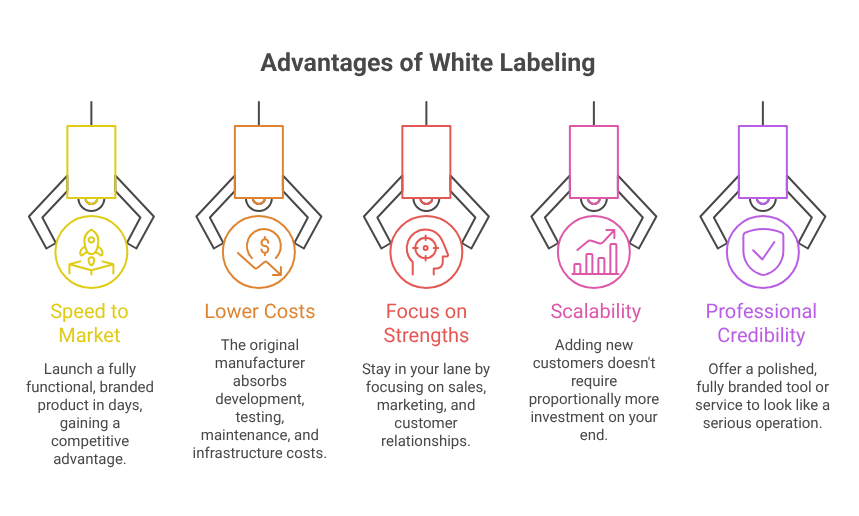
Below are some advantages:
Speed to Market
Building a product from scratch takes months – sometimes years. With white labeling, you can launch a fully functional, branded product in days. This is a massive competitive advantage when market timing matters.
Lower Costs
Development, testing, maintenance and infrastructure costs are all absorbed by the original manufacturer. You don’t pay for the R&D – you just pay for the license and put your name on it.
Focus on What You’re Good At
If your strength is sales, marketing and customer relationships, not coding. White labeling lets you stay in your lane. You don’t need a dev team. You don’t need to know how the backend works. You sell, the manufacturer builds.
Scalability
Adding new customers doesn’t require proportionally more investment on your end. The manufacturer handles the scaling infrastructure. You just bring in more clients.
Professional Credibility
Offering a polished, fully branded tool or service makes you look like a serious, established operation even if you’re a small team or a solo freelancer.
Disadvantages of White Labeling
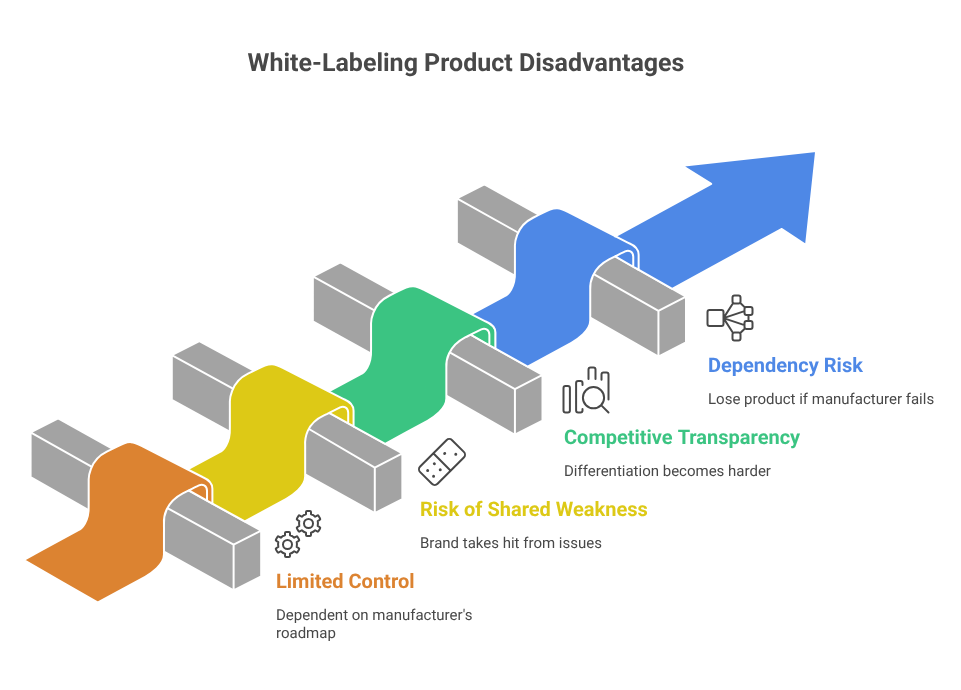
Below are some disadvantages:
Limited Control Over the Product
You can’t fix bugs yourself. You can’t add features to your timeline. If the manufacturer makes a change you dislike, your hands are often tied. You’re dependent on someone else’s roadmap.
Risk of Shared Weakness
If the manufacturer’s product has a security vulnerability, an outage or a PR problem, your brand takes the hit – even though you had nothing to do with it.
Competitive Transparency
Savvy clients may eventually recognize the underlying platform, especially in the SaaS world. If multiple competitors are using the same white-label tool, differentiation becomes harder.
Dependency Risk
If the manufacturer shuts down, dramatically changes its pricing or exits the market, you lose your product overnight. Always read the contract carefully.
White Labeling in the Software Industry
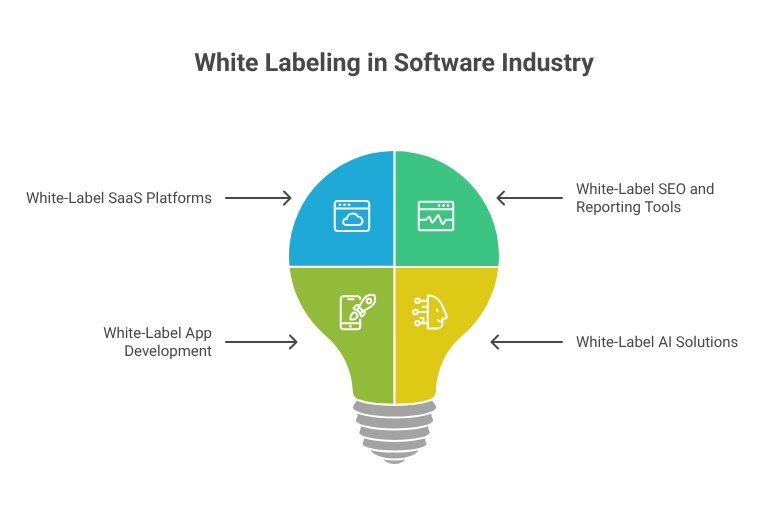
The software industry has embraced white labeling more aggressively than almost any other sector. And it makes sense when you think about it. Software can be copied perfectly, updated remotely and delivered to anyone on the planet at near-zero marginal cost. These properties make it a dream product for white labeling.
Here are some of the most common forms white labeling takes in software:
White-Label SaaS Platforms
Marketing automation tools, CRM systems and project management software. All of these are commonly sold as white-label platforms. An agency might license a marketing automation tool, rebrand it entirely and sell “their” marketing platform to clients at a premium. The clients get a solid tool. The agency gets recurring revenue without building anything.
White-Label SEO and Reporting Tools
Digital marketing agencies rely heavily on white-label SEO tools and reporting dashboards. Rather than building their own analytics platform, they license a white-label reporting tool, brand it with their logo and present it to clients as their proprietary reporting system.
White-Label App Development
This is a booming space. Companies that need mobile apps but can’t afford custom development turn to white-label app builders. These platforms allow significant customization while doing the heavy technical lifting behind the scenes.
White-Label AI Solutions
As AI tools proliferate in 2026, white-label AI solutions are emerging as one of the hottest categories. Companies can offer AI-powered chatbots, content generators, image tools and analytics under their own branding. All are built on top of an underlying AI infrastructure that they license from specialized providers.
The white-label SaaS market is projected to continue its explosive growth through the late 2020s, driven by the increasing demand for branded digital experiences and the rising cost of custom software development.
White Labeling in the WordPress Industry
WordPress powers over 40% of the web. And the white-labeling opportunities within its ecosystem are enormous. Whether you’re building client websites, running a WordPress agency or developing your own plugins and themes, white labeling plays a central role.
Here’s why it matters so much in WordPress. Most clients don’t care about the underlying tools. They care about the website working beautifully, their brand looking polished and the admin experience feeling like something built just for them. White labeling makes all of that possible.
How WordPress White Labeling Typically Works
Agencies and developers use white-label WordPress plugins and themes to build client sites, removing all third-party branding from the admin interface. The client logs into the WordPress dashboard and sees only the agency’s branding. Not the names of the plugins or page builders used to build the site.
This serves two purposes – it looks more professional and it protects the agency’s workflow. Clients who see the underlying tools might try to replicate the setup themselves or take the project to a cheaper competitor.
A Real-World White Labeling Example
One of the best examples of white labeling in the WordPress world is Element Pack. Element Pack is a powerful Elementor addon built by BdThemes that comes with robust white-labeling capabilities designed specifically for agencies and professionals.
With Element Pack’s white-label features, you can:
- Remove the “Element Pack” branding entirely from the plugin.
- Replace it with your own agency name and logo.
- Customize the plugin description and support links to point to your own documentation.
- Present the entire toolkit to clients as your own proprietary page-building solution.
For an agency building dozens of client sites, this is a game-changer. Clients see a professional, branded experience throughout. The agency looks like it has built sophisticated proprietary tools. And behind the scenes, Element Pack is doing all the heavy lifting.
Read more: Element Pack Pro White Label Branding
Another Example of White Labeling for WooCommerce
Another excellent example is StoreKit, also from BdThemes. StoreKit is a feature-rich WooCommerce addon and like Element Pack, it comes with white-label options that let agencies and store developers present it as their own branded toolkit.
If you’re building eCommerce stores for clients, being able to say “here’s our proprietary WooCommerce enhancement suite” rather than pointing clients toward a third-party plugin is a real competitive differentiator. It positions you as a full-service, professional operation – not just a freelancer assembling other people’s tools.
Future Trends: AI Agents and White Labeling

We’re entering a new era for white labeling – and AI is at the center of it.
As AI agents and large language model tools become mainstream business utilities, a new category of white-label products is emerging. AI-powered tools that any business can brand and deploy as their own. The underlying models are built and maintained by AI companies. The branding, the interface and the customer relationship belong entirely to the reseller.
What This Looks Like in Practice
Imagine a marketing agency offering “their” AI content assistant – a tool that writes blog posts, social captions and email campaigns for clients. Behind the scenes, they’re using a white-label AI writing platform built on top of a foundation model. The agency pays a licensing fee, customizes the interface with their branding and charges clients a monthly subscription.
The same model applies to AI chatbots for customer service, AI-powered SEO tools, AI image generators and AI analytics dashboards. The infrastructure is shared; the brand is unique.
The White-Label AI Market in 2026
In 2026, white-label AI solutions are one of the fastest-growing categories in B2B software. Companies that previously couldn’t afford to build AI capabilities in-house are now licensing them wholesale. And building genuine competitive advantages on top of commoditized AI infrastructure.
This creates an interesting dynamic – the underlying technology becomes a commodity, but the brand, the customer relationship and the integration quality are what create real business value. That’s the heart of the white-labeling proposition – applied to the most transformative technology of our time.
What to Watch
- AI agents as white-label service providers (automated tasks sold under agency brands)
- Verticalized white-label AI platforms (tools built for specific industries, resold by specialists)
- Embedded AI features in existing white-label SaaS products
- Increasing customization options that make white-label AI tools harder to distinguish from custom builds
Considerations When Choosing a White-Label Partner
Not all white-label vendors are created equal. Choosing the wrong partner can leave you with a mediocre product, unreliable support and unhappy clients. Here’s what to evaluate carefully before committing:
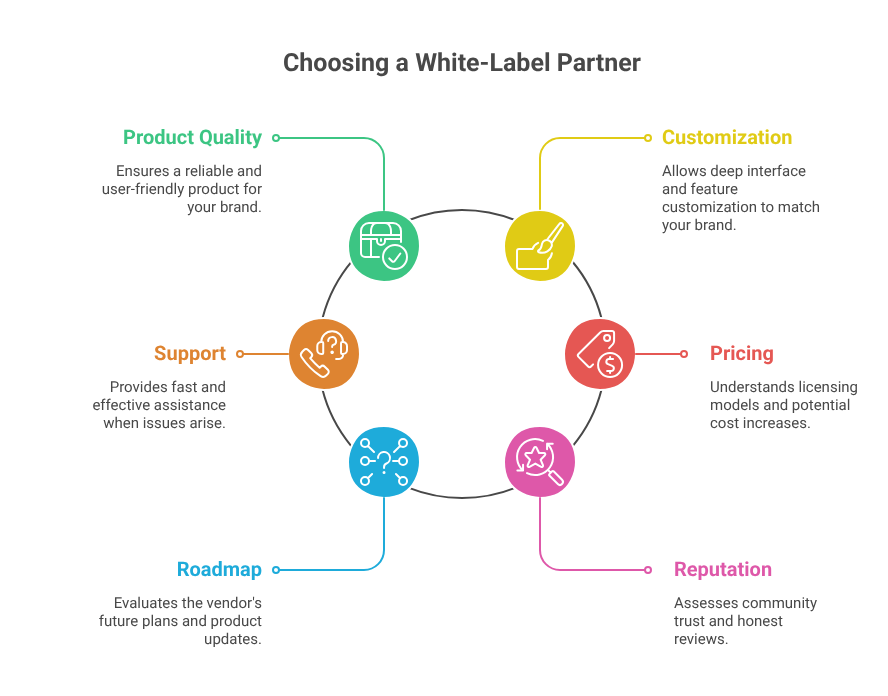
Product Quality and Reliability
This is non-negotiable. Test the product thoroughly before reselling it. If it crashes, behaves inconsistently or has a frustrating user experience, your brand takes the blame, even if you didn’t build it.
Depth of White-Label Customization
Some vendors offer superficial white labeling. You can change the logo and little else. Others let you customize the interface deeply, rename features, set up custom domains and eliminate their branding. Know exactly what level of customization you’re getting before signing.
Support Quality
When something breaks, you need to be able to get help fast. Evaluate the vendor’s support responsiveness, documentation quality and community resources. A white-label tool with no support structure can become a nightmare when client sites go down.
Pricing and Contract Terms
Understand the licensing model completely. Is it per user? Per site? A flat monthly fee? What happens to your clients’ data if you stop using the platform? Are there usage limits that could unexpectedly increase your costs?
Long-Term Roadmap
You’re betting part of your business on this vendor’s continued existence and improvement. Ask about their product roadmap, their funding situation (if relevant) and their track record of shipping updates. A vendor that hasn’t updated their product in 18 months is a risk.
Reputation and Community Trust
Search for honest reviews, community discussions and case studies. Talk to other agencies or businesses that use the tool. The white-label vendor community is often smaller and more candid than the broader market – use that to your advantage.
A strong white-label partner feels like an extension of your own team – reliable, responsive and committed to helping your business succeed.
Conclusion
White labeling is one of those business strategies that sounds almost too good to be true. Until you realize how many of the products and services around you are already built on it.
It allows businesses of all sizes to move faster, look bigger and serve clients better – without the enormous overhead of building everything from scratch. It lets manufacturers scale distribution without building sales teams. And it creates entire ecosystems of specialized resellers who understand their customers better than any single manufacturer ever could.
In the digital world, from SaaS platforms to WordPress plugins to AI tools, white labeling has become an essential part of how products get built and delivered. Tools like Element Pack and StoreKit from BdThemes exemplify how thoughtfully implemented white-label features can empower agencies to build stronger, more professional businesses.
Whether you’re a buyer looking for the right white-label tool, a seller thinking about white-labeling your own product or simply someone trying to understand the business models behind the software you use every day, the core idea is simple. The best product doesn’t always win. The best brand does. And white labeling is how smart businesses build winning brands without building everything themselves.
Ready to explore white labeling for your WordPress projects? Check out Element Pack, StoreKit and the full suite of tools from BdThemes.
Frequently Asked Questions
Q1: What is white labeling?
White labeling is when one company makes a product and another company sells it under their own brand name. The customer only sees the reseller’s branding, not the original maker.
Q2: What is the difference between white labeling and private labeling?
White-label products are sold to many resellers without changes. Private label products are made exclusively for one brand, often with custom features. White label = same product, many brands. Private label = custom product, one brand.
Q3. How does white labeling work in software (SaaS)?
A company licenses a ready-built SaaS product, adds its own logo and domain, and sells it to clients as their own tool. The original vendor handles all updates and maintenance behind the scenes.
Q4. What are the benefits of white labeling for agencies?
Agencies can offer more services faster and at lower cost. Instead of building tools from scratch, they license white-label solutions and focus on client relationships, branding, and sales.
Q5. What is the difference between white label and reseller?
A reseller sells a product under the original brand’s name. A white-label partner removes all original branding and presents the product as their own. The difference is entirely about branding ownership.
Q6. What are examples of white-label software products?
Popular examples include rebranded CRM tools, email marketing platforms, and WordPress plugins like Element Pack and WooCommerce addons like StoreKit. These let agencies present third-party tools as their own branded products.
Q7. How much does white-label app development cost?
White-label app platforms typically cost $50 to $500 per month for most businesses. Custom app development, by comparison, can cost $50,000 or more. Exact pricing depends on features, users, and the level of customization needed.
Q8. What are the legal risks of white labeling?
Key risks include unclear IP ownership, liability for product issues you did not cause, data privacy responsibilities, and dependency on the vendor’s continued operation. Always review contracts carefully before signing.
Q9. What should I look for in a white-label partner?
Look for product reliability, deep branding customization, responsive support, transparent pricing, and a clear product roadmap. BDThemes is a good example of a vendor that builds white-label functionality as a core feature, not an afterthought.
Q10. Are there AI white-label solutions available in 2026?
Yes. Businesses can now license AI-powered chatbots, content tools, image generators, and analytics platforms, then rebrand them as their own products. AI white-label solutions are one of the fastest-growing categories in B2B software this year.
Md Tarikul
The BdThemes team builds WordPress plugins trusted by 3M+ users worldwide. We write about web accessibility, WCAG compliance, and inclusive design.